 Victor Arias
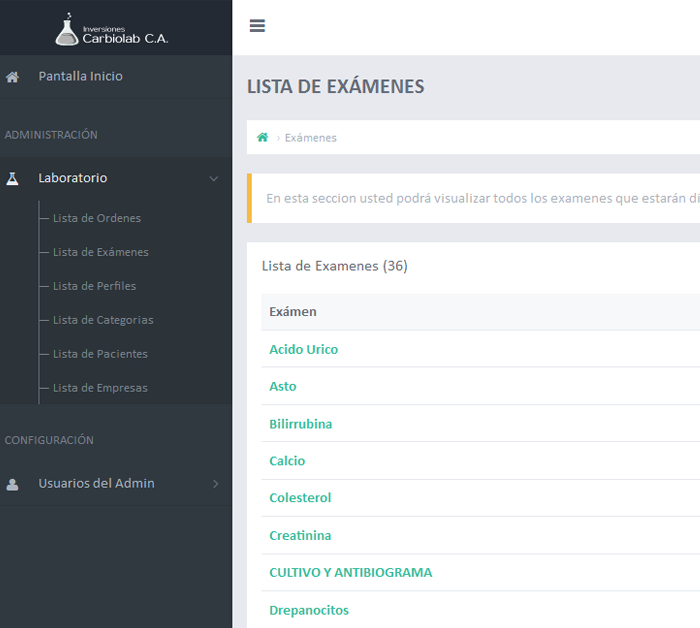
Carbiolab System is a clinical analysis laboratory whose admin system — orders, exams, profiles, patients and companies — we developed and maintain as a managed service: 24/7 monitoring, automated backups, proactive maintenance and updates, user support, permission management, infrastructure and network and protection of patient data. The service sustains 99.9% availability and has cut incidents by 70%.
| Client | Carbiolab System |
| Industry | Clinical laboratory |
| Service | Managed IT Services |
| Stack | Custom system, 24/7 monitoring, Automated backups, Proactive maintenance, Updates, User and permission management, Infrastructure and network, Security and patient data |
| Duration | Ongoing service |
| Our role | End-to-end management of the laboratory's admin system: 24/7 monitoring, automated backups, proactive maintenance and updates, user support, permission management, infrastructure and network and protection of patient data. |
| Published | January 13, 2026 |
A laboratory cannot afford a system that fails mid-morning: samples arrive, results are expected and every lost hour turns into patients calling to ask whether their test is ready. Yet most system failures do not arrive all at once: they build up as unpatched versions, untested backups and alerts nobody is watching.
Carbiolab System is a clinical analysis laboratory whose admin system — orders, exams, profiles, patients and companies — we developed and maintain as a managed service: 24/7 monitoring, automated backups, proactive maintenance and updates, user support, permission management, infrastructure and network and protection of patient data. The service sustains 99.9% availability and has cut incidents by 70%.
The challenge: the laboratory's system cannot fail during working hours
A laboratory admin system has a clear schedule and a clear demand: it works when the laboratory works and it cannot stop doing so. That rules out two very common things: improvising and maintaining 'when there is a gap'.
Samples and deadlines do not wait
The laboratory flow is continuous: sample intake, registration, processing and delivery of results. If the system goes down at any point in that chain, the work does not pause: it piles up, and then it has to be recovered in a hurry and with more risk of error.
Maintenance gets postponed until it hurts
When nobody is assigned that task, updates are delayed, backups are left untested and disks fill up without anyone noticing. None of those problems shows up in the first month; all of them appear on the least convenient day.
Clinical data, not just any data
The system holds patient information: who had which test and when. That makes it essential to control access, protect backups and know exactly which user can see what. Security is not an extra in the service, it is part of the service.
The solution: managed services on a system we built
The system is ours and we maintain it, so there are no intermediaries between whoever detects a problem and whoever can fix it. The service covers the full cycle: watch, maintain, update, protect and attend to the people who use it daily.
 The laboratory works with samples and deadlines: every hour with the system down is a result reaching a patient late.
24/7 monitoring and proactive maintenance
The system and the servers are watched continuously, with alerts that warn before the problem reaches the user. Proactive maintenance rests on that watching: reviewing, tuning and updating before something fails, which is where the incidents that never happen are won.
Automated backups and tested restores
Backups run automatically and, above all, restoring them is tested. A backup that has never been restored is an assumption, and in a laboratory that assumption is discovered on the day patient data is lost and weeks of work have to be redone.
Users, permissions, network and security
Users and their permissions are managed from the service, as are the infrastructure and network that hold the system up. On the security side, access and backups are treated as clinical data: with encryption, role-based control and a record of what is done.
How we organise it
A managed service rests on two things: knowing what is happening at all times and reviewing it with data every so often. Without the first you are always chasing; without the second you cannot prove the service works.
 Monitoring is there to find out before the user does: most incidents are solved without anyone noticing.
A single panel of what is happening
Availability, service status, backups taken, alerts and user requests live in the same place. A single panel avoids the most common situation in an unmanaged service: finding out about problems by chance, when someone calls.
Regular review with data
Each period the service figures are reviewed: availability, logged incidents, updates applied and restores tested. That review is what makes it possible to decide whether anything in the infrastructure needs to change and what turns the service into something measurable rather than debatable.
Results
The service is running with monitoring, automated backups, proactive maintenance, user support and the management of permissions and infrastructure. These were the needs and how they were solved:
| Need | How it was solved |
| Finding out about a failure once it affects the laboratory | 24/7 monitoring with alerts |
| Losing data to a mistake or a deletion | Automated backups with tested restores |
| Breakdowns that repeat every month | Proactive maintenance and updates |
| Users unable to work | Support for the laboratory's users |
| Uncontrolled access to clinical information | User, permission and security management |
| Servers and network as a source of problems | Infrastructure and network management |
The measured results of the service: 99.9% availability and 70% fewer incidents. Both figures describe the same change: when someone monitors, maintains and updates continuously, most problems are solved before they become a call from the laboratory.
What a system that cannot go down needs
If your system is critical to daily work and nobody is assigned to watch it, these are the points worth covering:
- Continuous monitoring, because finding out from the user is finding out too late.
- Automated, tested backups, since a backup without a tested restore protects nothing.
- Proactive maintenance, which is where the incidents that never happen are prevented.
- Up-to-date software, because old versions are the usual way in for problems.
- Permissions and security matched to the data, especially when patient information is involved.
- Regular review with figures, to know whether the service is working or only looks like it.
If your system cannot go down and nobody is watching it, our managed IT services page explains how we work, and you can write to us to go through it together.
Frequently asked questions
What is the difference between support and managed services?
Support reacts once something has broken: someone reports it and it gets fixed. Managed services monitor, maintain and update so that it never gets that far. The difference shows in the incidents that do not happen, which are most of the ones prevented by regular review.
Why does 24/7 monitoring matter in a laboratory?
Because a laboratory works with samples and deadlines. A system down first thing in the morning delays sample intake and the results patients are waiting for. Continuous monitoring is what makes it possible to fix a problem before anyone notices it at the front desk.
How is patient data protected?
With role-based permissions, tested backups, encryption and access control. In a laboratory the information is not commercial, it is clinical: who can see what and what happens to that data matters as much as the system being available.
What is reviewed every month in a managed service?
Availability, logged incidents, backups taken and restorations tested, updates applied and the state of infrastructure and network. That review is what turns the service into something measurable instead of a promise to keep an eye on things.