 Victor Arias
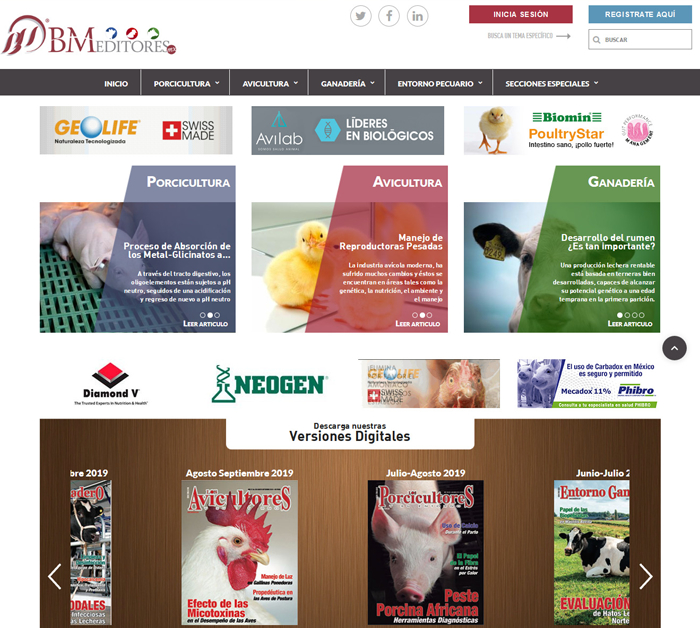
BMEditores is an online agricultural magazine built on WordPress with custom development: several titles — swine, poultry and cattle —, articles published by section, downloadable digital editions, reader registration, search, advertising space for industry advertisers and a newsletter. After the project readers rose 120% and the portal went on to manage 3 magazines.
| Client | BMEditores |
| Industry | Livestock and agriculture |
| Service | WordPress Development |
| Stack | WordPress, PHP, MySQL, Custom theme, Publishing by section, Multiple titles, Digital editions (PDF), Reader registration, Advertising and newsletter |
| Duration | 1-2 months |
| Our role | Custom development on WordPress for the magazine: a bespoke theme with articles published by section, several titles (swine, poultry and cattle), downloadable digital editions, reader registration, search, advertising space and a newsletter. |
| Published | January 10, 2024 |
A trade magazine is not sustained by a nice cover: it is sustained by publishing every week, sorting every article into its section and proving to advertisers that their message reaches people who work in the industry.
BMEditores is an online agricultural magazine built on WordPress with custom development: several titles — swine, poultry and cattle —, articles published by section, downloadable digital editions, reader registration, search, advertising space and a newsletter. After the project readers rose 120% and the portal went on to manage 3 magazines.
The challenge: a trade magazine lives on publishing and segmenting
A specialised publication serves two customers at once: the reader, who wants useful information about their trade, and the advertiser, who wants to reach exactly that reader. The portal has to serve both without turning editorial work into a bottleneck.
Publishing often without losing order
Content in a trade magazine is constant: technical articles, product news, farm case studies. If every publication depends on someone touching code, the pace drops and so does the audience, which in this industry feeds on repeat visits.
Three different audiences in one portal
Swine, poultry and cattle are not the same reader: they are professionals with different problems who share an industry. Serving them from a single portal means separating content well without multiplying the team's work or the infrastructure.
Advertisers pay for audience, not for visits
An animal nutrition advertiser does not buy impressions: they buy standing in front of pig producers. Advertising in a trade magazine rests on segmentation, and that depends on how the content is organised.
The solution: WordPress with custom development
The base is WordPress because a magazine's day-to-day is publishing and organising, and that is already solved: roles, categories, scheduled publishing and an editor the team knows. Custom development adds what no template covers: several titles, digital editions, reader registration and advertising space.
 A trade magazine's work is constant: the portal has to make publishing easy and put every article in its section.
Articles by section and several titles
Every article is published inside its section and its title, so the reader finds what interests them without crossing content from another industry. The team works in a single panel and the three magazines share structure, templates and publishing criteria.
Digital editions and reader registration
The print editions are offered as downloadable digital versions, which is how a large part of the industry's readers consult them today. Reader registration also makes it possible to know who comes back and to notify them of every new issue by newsletter.
Advertising, search and newsletter
Industry advertisers have their spaces inside the portal, with the advantage that each title is a specific segment. The search solves the technical query — an article from two years ago about managing breeders — and the newsletter turns a one-off visit into an audience that returns.
How we implemented it in one to two months
The project started with the editorial structure, not the design: which sections exist, which titles there are and what each role can publish. That is the order that avoids rebuilding the portal once the team is already publishing daily.
 Digital editions extend the print issue to readers who consult it from a phone or desktop.
Sorting the editorial structure before building
The tree of sections and titles was defined, along with content types and the roles of each team member. With that closed, development is limited to building on top of a structure that already matches how the newsroom works.
Leaving the portal ready to grow in titles
The structure was built with new titles in mind, so adding one is a configuration task, not a project. In an industry where publications are grouped by speciality, that flexibility is what allows growth without multiplying maintenance.
Results
The portal was delivered with the three titles, publishing by section, digital editions, reader registration and advertising spaces working. These were the needs and how they were solved:
| Need | How it was solved |
| Publishing often without mixing topics | Articles organised by section |
| Reaching different audiences in the industry | Several titles in one portal |
| Offering the print edition digitally | Downloadable digital editions |
| Knowing and retaining readers | Reader registration and newsletter |
| Letting readers find an older article | Content search |
| Funding the publication | Advertising space for industry advertisers |
The measured results of the project: readers rose 120% and the portal went on to manage 3 magazines. Both figures tell the same story: when publishing is easy and content is organised by audience, the magazine grows in readers and in titles without the effort growing with it.
What an online trade magazine needs
If you publish specialised content and want it to last, these are the points that decide whether the portal holds up:
- A clear section structure, because that is what lets you publish fast without cluttering the archive.
- Several titles when there are several audiences, so different industries are not mixed on the same home page.
- Downloadable digital editions, which is how much of the industry reads the print issue.
- Reader registration and newsletter, to turn one-off visits into a recurring audience.
- Content search, because the value of a technical magazine also lies in its archive.
- Segmented advertising space, which is what makes a trade publication sustainable.
If your publication needs structure, titles and advertising properly set up, our WordPress development page explains how we work, and you can write to us to go through it together.
Frequently asked questions
Why WordPress for an online magazine?
Because a magazine's daily work is publishing often and sorting every article into its section, and WordPress handles that out of the box: editorial flow, roles, categories and scheduled publishing. Custom development adds what the industry needs: several titles, digital editions, reader registration and advertising space.
What do several titles in one portal add?
Different audiences — swine, poultry and cattle — served with a single team and a single infrastructure. For advertisers, each title is also a specific segment to target, which is exactly what they look for in a trade publication.
How does an online trade magazine make money?
From advertising by industry advertisers, which only works if the audience is well segmented: the value of ad space in an agricultural magazine lies in the fact that whoever sees it works in the industry. That is why the structure by section and title is a commercial decision as much as an editorial one.
How long does an online magazine with several titles take?
This project was delivered in one to two months. The schedule is set by the structure of sections and titles, downloadable digital editions, reader registration, search, advertising and the newsletter.