 Victor Arias
A health products distributor had its new site in staging behaving like a shop: cart, checkout and its own prices when the sale happens in an external store. In five days it became an informational site: purchases are sent to the store with 301 redirects, the regulatory categories on the product pages were corrected (a supplement appeared as micronised and a topical cream as an oral supplement), the filler blog was hidden, the contact details were replaced and the legal pages were rewritten, with consent and an SEO base in the theme. TTFB went from 2.6–3.0 s to 0.54–0.66 s on cached pages and the HTML from 99 KB to 17 KB.
| Client | Health products distributor |
| Confidentiality | Client name, screenshots and links are omitted at the client's request. The diagrams describe the solution and the techniques applied. |
| Industry | Health products distribution |
| Service | WordPress Development |
| Stack | WordPress, WooCommerce (catalogue only), Elementor Pro, Child theme, Cache Enabler, SEO in the theme, GA4 with consent, gzip and headers, SSH/SCP |
| Duration | 5 days |
| Our role | Audit of the staged site and conversion from shop to informational site: purchase model, product content, home, blog and contact, legal pages, consent, technical SEO and performance. |
| Published | October 20, 2026 |
A health products distributor had its new website in staging, ready to launch, and it still behaved like a shop: cart, checkout, an account area, prices and buy buttons, when the sale happens in its external store. The site did not sell, but it did not inform either: the product pages described the products under the wrong regulatory category and the legal pages talked about a store that was not this one.
The job was not a redesign but a pre-launch clean-up: change the purchasing model, correct the regulatory content, adapt the legal pages and put in place the technical and SEO base that was missing. In five days, in staging and with backups, the site was ready to publish. Under our confidentiality agreement neither the client nor the products are named.
The challenge: a site that sold without being the shop
The final domain did not exist yet: everything was tested in staging. That gave room to change things, but it also meant every mistake would reach launch if nobody fixed it.
The purchase was in the wrong place
The “Buy” button scrolled to a section of the home page and the product pages carried a price, a quantity selector, a cart and an account area. The real sale happens in the distributor's store, so every purchase step on this site was a dead end: a user could fill a cart that went nowhere.
Two products, two categories explained wrong
A food supplement is one thing and a topical medical device is another, and the site treated them the same. One supplement appeared as “micronised, 2 microns” when the product is ultramicronised, and a topical cream was described as an oral supplement with vitamins and minerals it does not contain. There were also advertising claims, and the warnings were missing.
Template, legal and technical debt
The blog had eight filler posts and eight filler categories, the contact page showed a fictitious phone number and the legal pages mentioned the store as if it were this site: the privacy page displayed the legal notice and the terms were purchase terms dated 2022. Technically: a duplicated title, no meta description, no H1, no alt text, no Open Graph, a TTFB of 2.6–3.0 s and horizontal overflow on mobile.
The diagnosis: it was not a design problem
The failures came from three decisions taken before the design: what business model the site has, how a regulated product is described and what role the CMS plays. None of them is fixed with CSS.
The model: inform, not sell
If the sale happens in another store, the site has to send people there. WooCommerce can stay for the product page — data, presentation, warnings — but without a cart, without checkout and without an account. The purchase has one destination and the path should have no intermediate steps.
The category: language changes the regime
A food supplement cannot be described as a medicine and a topical medical device cannot be presented as an oral supplement. The copy, the warnings and the claims had to follow the distributor's material, since the distributor is the one answering to the health authority. And the technical side is fixed in the theme: with five pages, adding an SEO plugin meant extra weight and dependencies for what the child theme could already do.
The solution: what changed on the site
The work was done point by point, with a backup beforehand and a check afterwards, so each change could be reverted without dragging the others along.
The purchase, out of the site
The menu and the buttons lead to the distributor's store, and each product has its direct link. The cart, the account, the price and the quantity selector were removed, and the cart, checkout, account and shop URLs now redirect with a 301 to the store, leaving no dead routes or duplicate content behind.
The product pages, with the right category
The supplement page was corrected to ultramicronised and completed with presentation, national code, directions for use, manufacturer, distributor and warnings. The topical product was rebuilt as a cream, with its composition, directions and warnings, and the oral references were removed. On the home page, links were fixed, the duplicated paragraph and the claims were removed, and the rotating header now shows a product and a button.
Blog, contact and legal
The blog was hidden from the menu, emptied and marked noindex, out of the sitemap. The contact page moved to the distributor's real details, with a form and a linked GDPR checkbox. The legal pages were rewritten for an informational site: real privacy policy, terms of use instead of purchase terms, and adapted notice, cookies and disclaimer, with a dynamic domain so the migration does not force a rewrite.
SEO, consent and performance
One H1 per page, titles and meta descriptions of their own, alt text on product images and Open Graph with a 1200 × 630 image. GA4 does not load until consent is given, and clicks on purchase links fire an event. Page caching was enabled with Cache Enabler, plus gzip and headers, excluding the contact page so the form is not cached. The horizontal overflow of the mobile carousels was fixed.
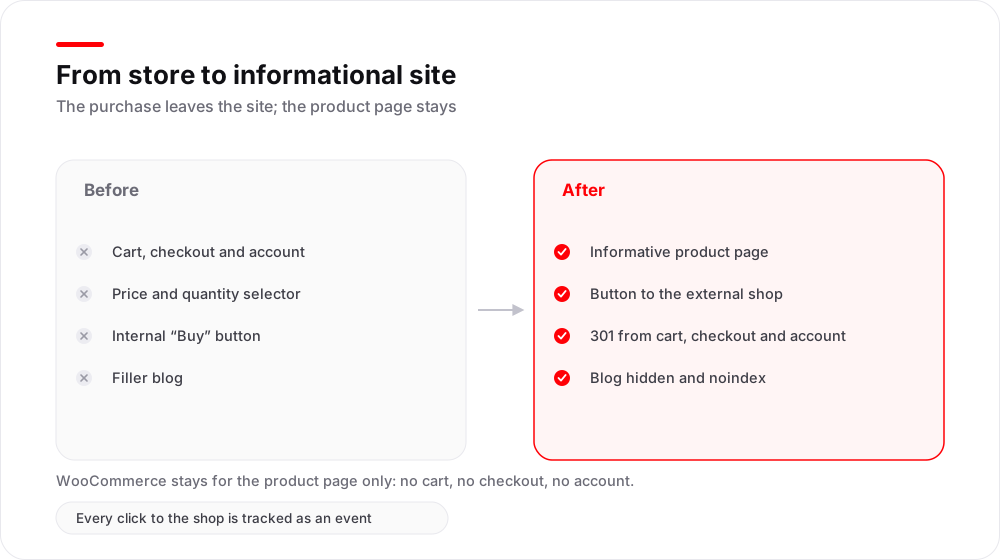 The model in one line: the site informs and the buy button leads to the store where payment happens.
How we did it in five days
Staging, backups and reversible changes
Everything was done on staging, with a copy of the database and the theme before touching anything. FTP was blocked from the working environment, so files were moved over SSH and SCP. Each change was checked on desktop and mobile, with before and after screenshots: menu, header, product pages, form, cookie notice and legal pages.
What was left to the client
The code leaves ready the pieces that depend on client decisions: the GA4 ID, the Search Console token, a real form submission and the final domain. The legal pages use a dynamic domain, so the migration does not force a rewrite; the cache only has to be cleared to regenerate the URLs.
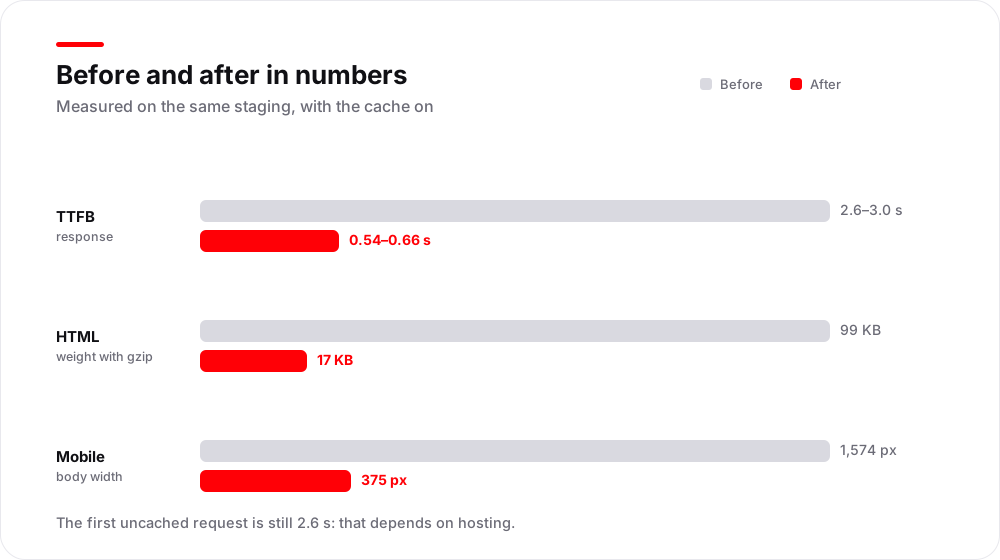 Three measurements from the same staging: cached response time, HTML weight with gzip and body width on mobile.
Results
The site stopped selling and started informing: purchases go to the store, the product pages describe the real category of each product and the legal pages match an informational site.
| Area | Before | After |
| Purchase | Own cart, checkout, account and prices | Everything goes to the store; 301 on shop routes |
| Product pages | Wrong category and incomplete data | Correct category, data, directions and warnings |
| Blog | Eight filler posts and eight categories | Hidden, empty, noindex and out of the sitemap |
| Contact | Template phone number and email | Distributor's real details and form with GDPR |
| Legal | Store wording and someone else's domain | Informational-site wording and dynamic domain |
| SEO | No unique title, meta, H1, alt or Open Graph | One H1, titles, metadata, alt and Open Graph |
| Performance | TTFB 2.6–3.0 s and 99 KB HTML | 0.54–0.66 s cached and 17 KB with gzip |
| Mobile | Horizontal overflow (1,574 px) | No overflow (375 px) |
Performance is the most visible number: TTFB went from 2.6–3.0 s to 0.54–0.66 s on cached pages and the HTML from 99 KB to 17 KB with gzip. The first, uncached request is still around 2.6 s: that depends on hosting, not on the code, and reviewing hosting or a CDN remains the recommendation.
What to check if your site is about to launch
In our experience, these are the points that turn a “finished” site into a publishable one:
- Does the buy button lead to the store or to a cart? If the sale is elsewhere, the path should have no intermediate steps and the old routes should redirect with a 301.
- Is the product category in the copy? Food supplement, medical device, medicine and cosmetic are not the same: they change the language, the warnings and what can be promised.
- Do the legal pages talk about this site? If they mention another store, or they are purchase terms for a site that does not sell, they are of no use.
- Is there one H1 and one unique title per page? Before adding plugins, check what the theme can already do.
- Does analytics wait for consent? If GA4 loads before acceptance, the banner is pointless.
- Does TTFB depend on hosting? Caching fixes the second visit; the first one is infrastructure.
If your site is in staging and you are not sure it is ready to launch, our WordPress development page explains how we work, and if you prefer to review your own case you can get in touch.
Frequently asked questions
Why adapt the existing site instead of building a new one?
Because the catalogue, the product pages, the images and the URLs were already built and tested: adapting them costs less than rebuilding, and nothing that works is lost. A new site would have duplicated content and forced a rewrite of the legal pages and the product copy. The work was done in staging, point by point and with backups, so every change was reversible.
Do you lose sales if the purchase leaves the site?
No: the sale is made by the distributor's store, and this site is the shop window that sends people there. What disappears is the intermediate step that did not work, a cart that could not take payment. Clicks on every buy button are tracked as an event, so you know how many people leave for the store and from which product page.
Is WooCommerce still needed if you do not sell?
It can work as a catalogue: it holds the product page, the attributes and the presentation without a cart or checkout. If the catalogue is small, the theme's own fields are enough and the plugin can go; here it stayed because the product pages were already built on it. The rule is that no purchase path remains inside the site.
What is the risk of changing the language of a regulated product?
A lot, if you do not start from the holder's material. A food supplement cannot promise what a medicine can, and a topical medical device is not described as an oral supplement: the warnings and what can be claimed both change. That is why the copy was aligned with the distributor's, since the distributor answers to the health authority, and the advertising claims were removed.
Why does TTFB not drop on the first visit?
Because the cache serves pages that are already generated: the first request still runs PHP and queries the database. Here the cache took TTFB to 0.54–0.66 s, but the first request was still around 2.6 s. Going below that means reviewing the hosting or putting a CDN in front: it is infrastructure, not code.