 Victor Arias
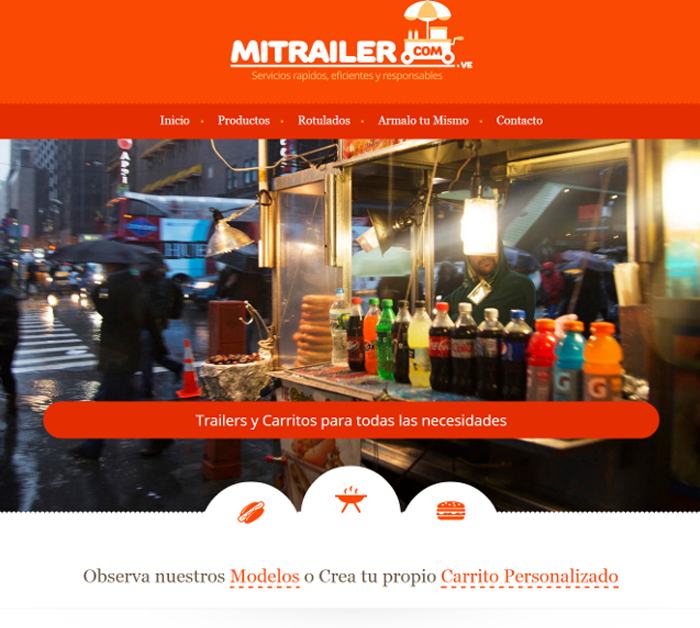
The Mi Trailer website was built from scratch on WordPress with a custom theme: a model gallery with technical specs, a quote request form and a news blog. The result was 70% more quote requests and 35% less load time.
| Client | Mi Trailer |
| Industry | Trailer and food cart manufacturing |
| Service | WordPress Development |
| Stack | WordPress, PHP, MySQL, Custom theme, Model gallery with specs, Quote request form, Image and page weight optimisation |
| Duration | 4-6 weeks |
| Our role | Design and development of the whole website — custom theme, model gallery, quote form and blog — plus launch. |
| Published | August 14, 2012 |
Mi Trailer manufactures trailers and food carts: made-to-measure product, much of it for street food, sold by showing it well and quoting fast. That is exactly what the website had to do, and it did not exist: the project started from scratch.
This case shows how it was built on WordPress with a custom theme — a model gallery with technical specs, a quote request form and a news blog — and what was done to keep it fast despite the large photos. The result: 70% more enquiries and 35% less load time.
The challenge: selling a made-to-measure product
A trailer or a food cart is not sold like a catalog item: every customer arrives with a different use in mind — a burger stand, a mobile coffee shop, a cargo trailer — and needs to know whether what we build fits their business. The website had to answer that question before anyone picked up the phone.
Showing product without losing the visitor
The catalog had to be organised by use and by product family, with pages stating the essentials — dimensions, capacity, equipment — and photos showing the product in context. A list of models with no data forces people to call and ask the basics, and that delays the conversation that actually matters.
The goal is not an online sale: it is an enquiry
Nobody buys a trailer with one click. The goal of the website is to get an interested visitor to tell us what they need: what for, by when and with which equipment. The whole design had to push towards that form.
Large photos and a website that loads fast
In this sector images are the sales argument and, at the same time, the enemy of performance: multi-megabyte photos take a long time to appear and make visitors leave before they have seen the product. The website was built with that balance in mind from the start.
The solution: a custom theme on WordPress
The website was built from scratch on WordPress with a custom theme, so the structure answers to the product and not the other way around. WordPress became the management panel so the team could publish models and news without depending on anyone, and the design was organised around the two actions that matter: seeing the model and requesting a quote.
 The product is shown assembled and in use: it is the fastest way for visitors to picture their own business.
Model gallery with technical specs
Every product family with its models, and every model with its specs: dimensions, capacity and equipment, with the photo gallery alongside. That way visitors compare options on their own, and the enquiry that arrives already comes with the groundwork done.
A form that collects what is needed
The quote request form asks for just what is needed to answer properly — product type, intended use, deadlines and contact details — without turning into a questionnaire that scares off someone who is still comparing.
A news blog to keep the website alive
The blog makes it possible to publish deliveries, modifications and recent jobs: content that almost updates itself with the daily work and helps the business show up in sector searches.
How we implemented it in four to six weeks
The project started from scratch, so the first part was about decisions: what is sold, how it is organised and what the visitor has to do on each screen. With that settled, development was straightforward and the last weeks went into fine-tuning: performance, forms and mobile testing.
 Beyond design, the fine-tuning work: optimised images and lighter pages, so the catalog is fast on mobile too.
Content before design
Before building the layout, the product families and the information on each page were defined. Working with the content in front of you avoids the classic problem: a design that looks beautiful with placeholder text and cannot handle the real copy or the real photos.
Optimisation: less weight, same visual quality
Images were fitted to the sizes in which they are actually shown and the weight of every page was reduced. The measured result was 35% less load time, which on a catalog with large photos translates directly into visitors who stay to look at the product.
Results
The website was delivered with the catalog loaded and the form tested. These were the needs of the project and how they were solved:
| Need | How it was solved |
| Explaining a made-to-measure product | Gallery by product family and technical specs with dimensions and equipment |
| Receiving complete enquiries | Quote form with product type, use and deadlines |
| Making the catalog fast to browse | Optimised images and lighter pages |
| Keeping content up to date | WordPress as the panel to publish models and news |
The result was 70% more quote requests and 35% less load time: more people finding the model they are looking for and fewer leaving before they see it.
What a manufacturer's website needs
If you build made-to-measure product, these are the points that decide whether the website works for you or is just there:
- A catalog by use and family, not by the workshop's internal order: visitors search for "what it does for me", not for a reference.
- Pages with concrete data: dimensions, capacity and equipment settle doubts without a phone call.
- A form that asks for what is needed, so a quote can be answered properly the first time.
- Optimised photos and a fast website, on mobile too: that is where people look things up from the street or a trade fair.
- A panel the team masters, because the catalog and the news change with every delivery.
If your website shows product and you also want it to bring in enquiries, our WordPress development page explains how we work, and you can write to us to go through it together.
Frequently asked questions
How do you organise a manufacturer's model catalog?
By product family and by use: every model with its technical specs (dimensions, capacity, equipment) and its gallery. A visitor looking for a trailer for a specific kind of business must recognise their case in the page without having to call to ask the basics.
Why a custom theme on WordPress instead of a template?
Because the goal of an industrial website is not publishing articles, but showing product and receiving enquiries. A custom theme lets you build the model page and the form around that decision, and keep in WordPress only what the team will actually use to keep the content up to date.
How do you make a website load faster?
On two fronts: page weight — properly sized and compressed images, without loading what is not seen — and technical cleanliness — fewer requests and fewer third party resources —. On websites with large product photos, working the images is usually most of the improvement.
What does a manufacturer's website need to generate enquiries?
A catalog that can be understood without help, pages with concrete data, a form that asks for little but asks for the essentials (product, use, deadlines) and a website that is also fast on mobile, which is where people look things up when they are out and about or at a trade fair.