 Victor Arias
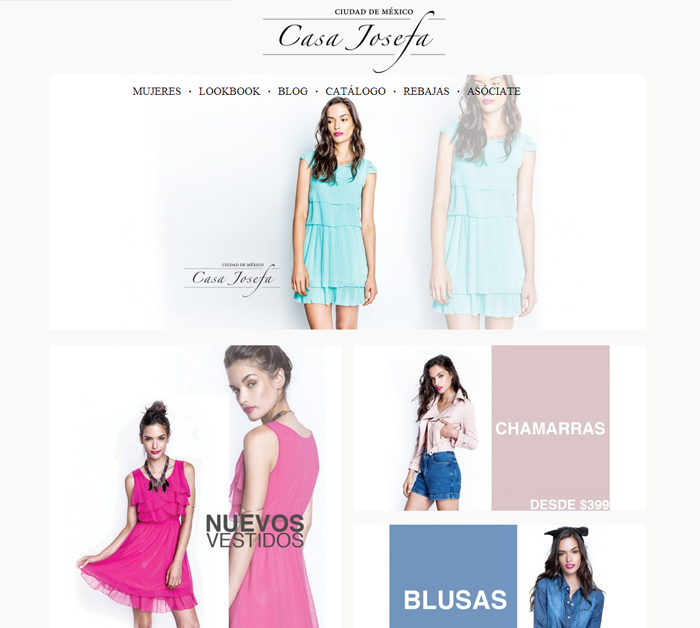
Casa Josefa is a women's fashion brand from Mexico City selling on Shopify with a theme of its own: a multi-category catalog with sizes and variants, payment gateways, national and international shipping, a lookbook and blog, an affiliate programme and performance and SEO work. Online sales grew by 140%.
| Client | Casa Josefa |
| Industry | Women's fashion |
| Service | Shopify Development |
| Stack | Shopify, Custom theme, Multi-category catalog, Sizes and variants, Payment gateways, National and international shipping, Lookbook and blog, Affiliate programme, Performance optimisation and SEO |
| Duration | 4-6 weeks |
| Our role | Store development on Shopify: custom theme, multi-category catalog with sizes and variants, payment gateways, national and international shipping, lookbook and blog, affiliate programme and performance and SEO work. |
| Published | May 14, 2026 |
A fashion brand does not only compete with other stores: it competes with the way people discover clothes, which is almost always a photo. The store has to hold up that image — the look, the season, the outfit — and at the same time work as commerce: sizes, stock, payments and shipping without friction. When either half fails, the sale that started in an image is left half done.
Casa Josefa is a women's fashion brand from Mexico City selling on Shopify with a theme of its own: a multi-category catalog with sizes and variants, payment gateways, national and international shipping, a lookbook and blog, an affiliate programme and performance and SEO work. Online sales grew by 140%.
The challenge: a brand discovered in a photo and bought on a product page
The brand already had something money cannot buy: a recognisable style and a community that followed it. What was missing was for that interest to turn into a purchase without losing the feel of the brand along the way, which is where most fashion stores fall down.
Fashion sells through images, not spec sheets
Someone buying clothes does not start by reading specifications: they start by looking. If the store does not show the garment as it looks worn, with light and as part of an outfit, the visit never reaches the product page. And if it does, the decision still rests on a photo that does not answer the only question that matters: how will it look on me.
A catalog that changes every season
In fashion the catalog is not a stable list: collections come in, garments go out and categories change. Without a clear structure — garment type, collection, season — the catalog becomes a warehouse where the customer has to search by hand, and searching by hand is where sales are lost.
Sizes, stock and shipping: where the sale falls apart
The most delicate moment in a fashion store is not payment: it is when the customer picks a size. If there is no size guide, if the variant is not clear or if she discovers at the end that her size is gone, the purchase is lost after the garment has already been liked. And if shipping does not reach beyond the city, the whole audience that follows the brand from elsewhere is lost too.
The solution: a Shopify store with the brand out front
The project was built on Shopify with a theme of its own, designed so the catalog can be reorganised every season without touching the design. The priority was not to have 'a pretty store', but for the store to look like the brand and work as commerce: variants, payments, shipping and content in the same place.
 In fashion the first sale is visual: the store has to show the garment as it looks worn, not only as it is described.
A custom theme and a multi-category catalog
The catalog was organised by garment type and by collection, with a theme of its own that respects the brand's style in every section. That structure is what lets product come in and out every season without rebuilding the store: the design stays and the catalog moves.
Lookbook and blog: content that sells
The lookbook and the blog live inside the store, not on somebody else's social network. A look leads to the garments that make it up and an article leads to the product page it mentions, so content stops being a loose image and becomes a measurable path to purchase.
Sizes, variants and payment gateways
Each product page handles size and colour variants with the information needed to decide without asking, and payment was solved with the gateways that fitted the customer. In fashion a clear size and a familiar payment method are worth more than any discount: they remove the doubt right before the purchase.
Selling inside and outside the country
The brand was born in Mexico City, but its audience is not limited to the city: clothes are discovered on social media and bought from wherever the person following the brand happens to be. That means the store has to resolve the distance without making the visitor work anything out for themselves.
 Selling beyond the city is a matter of logistics and trust: clear payments and shipping, and a product page that leaves no doubts.
National and international shipping
The store was set up to ship within the country and abroad, with the conditions visible before paying. When shipping is a surprise at the end, the customer from elsewhere abandons; when it is explained from the product page, distance stops being an obstacle and becomes a market.
Affiliate programme and speed
The affiliate programme gives shape to something that was already happening: customers and creators recommending the brand. Now the recommendation can be tracked and measured. Alongside it, the performance and SEO work made product pages and categories load fast and be findable, because in fashion a slow product page loses the sale that started on social media.
Results
The store went live with the custom theme, the multi-category catalog, the sizes and variants, the payment gateways, national and international shipping, the lookbook and blog, the affiliate programme and the performance and SEO work. These were the needs and how they were solved:
| Need | How it was solved |
| A brand that looks good on social media and weak on the web | Custom theme, performance and SEO |
| Collections and garment types mixed together | Multi-category catalog |
| Size doubts holding the purchase back | Sizes and variants |
| Payment options that did not fit the customer | Integrated payment gateways |
| Sales beyond the city and the country | National and international shipping |
| Content that stayed on social media | Lookbook and blog inside the store |
| Recommendations with no way to be measured | Affiliate programme |
The measured result: 140% more online sales. It is the figure that sums up the change: the same brand, the same community and the same product, but with a store that holds up the image and resolves the purchase instead of leaving it half done.
What decides whether a fashion brand sells online
If your brand works on social media but not in the store, these are the points worth reviewing before investing in more posts:
- A store that holds up the brand image, not a template that dilutes it.
- A catalog organised by garment type and collection, able to take the seasonal changes.
- Clear sizes and variants, with the information that removes doubt before payment.
- Payments and shipping that fit the buyer and the place they are buying from.
- Content of your own (lookbook, blog) that leads from the image to the garment's product page.
- Speed, because in fashion a slow product page loses the sale that started on social media.
If your brand looks good on social media and does not convert in the store, our Shopify development page explains how we work, and you can write to us to go through it together.
Frequently asked questions
Why Shopify for a fashion brand?
Because the catalog changes every season and the effort has to go into the brand and the garments, not the infrastructure. Shopify already handles the commerce basics — payments, stock, variants, shipping — so the work concentrates on how the collection is presented and how it is bought.
What does a lookbook inside the store add?
Fashion sells through images. The lookbook shows garments combined and leads from the outfit to the page for each piece, which is exactly how someone who follows a brand buys: they see a look, like one garment and want to know whether it comes in their size.
How is a catalog with many categories and sizes organised?
With categories by garment type and by collection, and size and colour variants inside each product page. If the structure is clear, filters and search lead to the specific garment and the most expensive problem in a fashion store is avoided: the customer finding something that is no longer available in her size.
What is an affiliate programme for in fashion?
So that whoever recommends the brand can earn from it and it can be measured. In fashion recommendations carry a lot of weight, and an affiliate programme turns customers and content creators into a sales channel with tracking, instead of mentions with no idea whether they bring purchases.