 Victor Arias
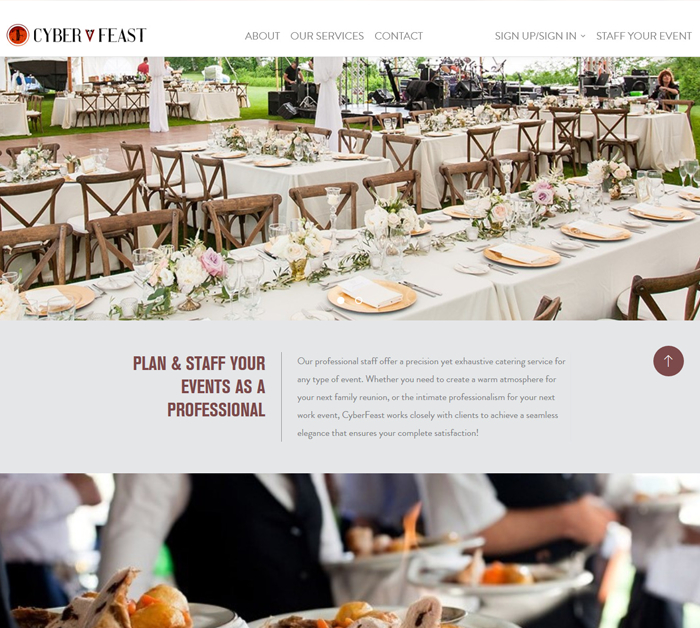
Handy Party is an events marketplace built from scratch: providers (catering, music, waiting staff…) register and build their profile, the customer posts the event and books online, the conversation continues over instant messaging inside the platform, and payment and ratings are recorded. The infrastructure runs with load balancing across AWS and DigitalOcean, and after the project the portal gathered more than 250 providers and halved booking time.
| Client | Handy Party |
| Industry | Events and weddings |
| Service | Custom development |
| Stack | Custom development, Instant messaging, Load balancing, AWS, DigitalOcean |
| Duration | 1-2 months |
| Our role | Custom development of the events marketplace: provider registration and profiles, event posting, online booking, instant messaging, payments and ratings, with load balancing across AWS and DigitalOcean. |
| Published | December 14, 2023 |
Organising an event does not fail for lack of providers: it fails when coordinating them. Catering, music, waiting staff, decoration… each one is a phone call, a quote and a different spreadsheet, and the time is gone before the party even starts.
Handy Party is an events marketplace built from scratch: providers register and build their profile, the customer posts the event and books online, the details are settled over instant messaging and payment and ratings stay inside the platform, with load balancing across AWS and DigitalOcean. After the project the portal gathered more than 250 providers and booking time was halved.
The challenge: coordinating an event is intermediary work
An event brings together several providers who do not know each other and a customer who has no reason to know who to hire. Somebody has to act as the intermediary, and until now that somebody was the customer with a phone in their hand.
Providers do not find each other on their own
Anyone organising a wedding or a celebration is not looking for "a provider", they are looking for catering for fifty people on a specific date and in a specific area. Without one place where they all are, with what they offer and at what price, every search starts from scratch.
Booking time goes into phone calls
Asking five providers for a quote means five parallel conversations, with answers arriving at different speeds and details that have to be written down to compare. That admin work is what eats the weeks before the event.
Without payment or ratings there is no trust
Hiring someone you do not know online for the most important day of your celebration needs more than a nice photo: it needs to know the booking will hold and that other customers were satisfied before.
The solution: an events marketplace built from scratch
It was built from scratch because the portal is not a showcase with forms: it is a flow with two user types, states for every event and conversations running in parallel. All of it lives in the same system, with load balancing across AWS and DigitalOcean.
 Providers — catering, music, waiting staff — are the supply side of the marketplace: their profile is their shop window.
Provider registration and profiles
Every provider registers and publishes a profile with the services offered, their prices and their working area. That is what turns a list of contacts into a comparable catalogue, and what lets the customer see real options without calling anyone.
Event posting and online booking
The customer posts the event with what is needed — date, place, number of guests and staff — and the booking is closed inside the portal. By posting once what used to be five calls, time stops going into repeating the same information to every provider.
Instant messaging, payments and ratings
Between the request and the event there is conversation: menus, times, last-minute changes. That conversation happens in the platform's instant messaging, payment or commission is handled inside and, when it is over, the customer rates the provider. The three together close the loop: agreement, guarantee and reputation.
How we implemented it in one to two months
The project started with the booking flow — register, post, book and charge — before the visible side. A marketplace that looks good but does not close a booking has nothing worth improving afterwards.
 The goal is for the event to arrive fully set up without the customer chasing anyone by phone.
Starting with the booking flow
Before designing we defined what happens from the moment a provider registers until an event is rated: what each side sees, how a request is made, how it is confirmed and what happens if no agreement is reached. That is the journey that holds the platform up, and the one worth closing before building on top.
Preparing for the seasonal peak
Events cluster: in high season many requests come in at once, with real deadlines. Behaviour under load was tested, splitting traffic across the two cloud providers with balancing, so that a surge in requests does not land on the worst possible week.
Results
The portal was delivered with provider registration, event posting, booking, payments and ratings working. These were the needs and how they were solved:
| Need | How it was solved |
| Finding providers without calling one by one | Provider registration with a public profile |
| Knowing what each one offers before booking | Profiles with services, prices and working area |
| Telling the platform what the event needs | Event posting with date, place and staff |
| Closing the booking without back and forth | Online booking inside the portal |
| Settling details until the last day | Instant messaging between customer and provider |
| Charging, answering for the service and building reputation | Payments or commissions and ratings after the event |
The measured results of the project: the portal gathered more than 250 providers and booking time was cut in half. Both figures tell the same story: when providers have somewhere to show themselves and customers can compare and book in the same place, the intermediary stops being the phone.
What an events marketplace needs
If your business connects customers with event providers, these are the points that decide whether the platform works:
- Provider registration and profiles, because without visible supply there is nothing to compare.
- Event posting, so the customer describes what is needed only once.
- Online booking, which is what removes the exchange of calls and emails.
- Messaging inside the platform, so the event details do not scatter.
- Payment and ratings, the guarantee for the customer and the reputation for the provider.
- Infrastructure with load balancing, because requests arrive clustered in high season.
If your project connects two sides and does not fit a template, our services page explains how we work, and you can write to us to go through it together.
Frequently asked questions
How is an events marketplace different from a providers website?
On a providers website the visitor has to contact them one by one and wait for each answer. On a marketplace they post their event once and the providers are the ones who respond, so coordination stops being the customer's job and becomes the platform's job.
Why should payment and ratings happen inside the platform?
Because payment and reviews close the loop. Without payment there is no guarantee the booking holds, and without ratings there is no reputation to check before hiring the next provider, which is what keeps service quality up.
What does instant messaging add before an event?
The details of an event change until the very last day: guest numbers, times, menus, location changes. Keeping the conversation inside the platform holds that context next to the booking instead of spreading it across scattered emails and messages.
How long does it take to build a custom events marketplace?
This project was delivered in one to two months. The schedule is set by provider registration and profiles, event posting, online booking, instant messaging, payments and ratings, and load balancing across the two cloud providers.