 Victor Arias
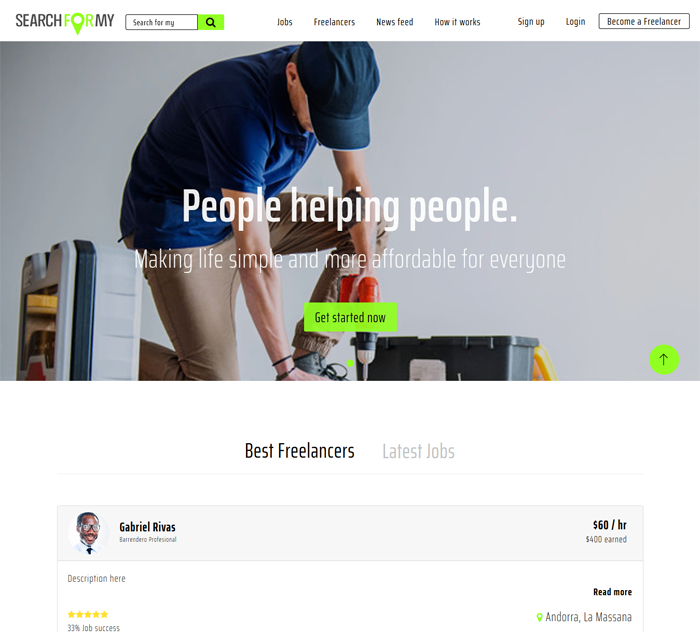
SearchForMy is a services marketplace built from scratch with Laravel and PHP: whoever needs a professional posts the job, professionals bid for it, the platform verifies profiles and the conversation continues over instant messaging until the deal closes. The infrastructure is split across DigitalOcean and AWS with load balancing, and after the project listings rose 180% with a 4.9-star rating.
| Client | SearchForMy |
| Industry | Services for crafts and trades |
| Service | Custom development |
| Stack | Laravel, PHP, MySQL, Instant messaging, Load balancing, DigitalOcean, AWS |
| Duration | 1-2 months |
| Our role | Full development of the platform with Laravel and PHP: service search, verified profiles, job posting, bidding system, instant messaging and ratings, with load balancing across DigitalOcean and AWS. |
| Published | July 14, 2023 |
A marketplace does not sell a product: it sells the meeting between someone who needs something done and someone who knows how to do it. Its problem is not design, it is getting both sides to show up at once and turning the first visit into a conversation.
SearchForMy is a services marketplace built from scratch with Laravel and PHP: search, job posting, bidding, verified profiles, ratings and instant messaging, with load balancing across DigitalOcean and AWS. After the project listings rose 180% and the average rating stayed at 4.9 stars.
The challenge: a marketplace has to start on both sides at once
A store with a catalog works from day one even if nobody visits. A marketplace does not: it needs professionals so there is something to search for, and posted jobs so there is a reason to sign up. And it needs the deal not to escape when both sides meet.
Without supply there is no demand, and the other way round
It is the classic two-sided platform problem. If visitors arrive and find nobody who does what they need, they do not come back; if professionals arrive and there are no jobs, neither do they. Getting off the ground depends on the flow working at low volume, not only once there is critical mass.
Here you hire strangers
In a services marketplace, whoever hires does not know the other side and has not seen their work. Trust is the scarce resource: without a way to know the person exists and how they have worked before, the decision moves off the platform and the deal is lost.
The deal closes in conversation
Between the bid and the finished job there is a conversation: details, deadlines, materials, changes. If that conversation moves to email or phone, the platform keeps the data from before and after but misses the centre of the project.
The solution: a platform built from scratch with Laravel and PHP
The platform was built from scratch with Laravel and PHP on MySQL, because a marketplace is not a catalog with forms: it is a flow with two user types, states for every job and conversations in progress. All of it lives in the same system, with load balancing across DigitalOcean and AWS.
 On the other side of every bid there is someone who makes a living from that trade: the platform has to make finding work easy for them.
Job posting and bidding system
Whoever needs the service posts the job with its requirements and professionals bid for it. That is the mechanism that lets the market set the price instead of fixing it from above, and what makes a job reach whoever can do it rather than whoever is closest.
Verified profiles and ratings
Each profile gathers what is needed to decide: which services are offered, at what price, where the person is and what rating they have from previous jobs. Verification answers whether the person exists; ratings answer how they work.
Instant messaging and load balancing across two clouds
The conversation between customer and professional happens inside the platform, over instant messaging, so the project context stays next to the bid. Underneath, the load is split across DigitalOcean and AWS with balancing, so traffic depends neither on a single provider nor on a single server.
How we implemented it in one to two months
The project started with the full flow — post, bid, talk and close — before the look of the platform. A marketplace that looks good but does not close a deal has nothing worth improving afterwards.
 The goal of the platform is for the conversation to end in work done, not in a saved contact.
Starting with the full flow
Before designing we defined what happens from the moment a job is posted until it is rated: who can bid, what each side sees, how the job is closed and what happens if no agreement is reached. That is the journey that holds the platform up, and the one worth closing before building on top.
Testing the peak and the load split
Behaviour under load was tested, checking that splitting traffic across the two cloud providers keeps the platform standing when more people come in. In a platform with real-time messaging, an outage is not just an annoyance: it cuts open conversations.
Results
The platform was delivered with job posting, bidding, messaging and ratings working. These were the needs and how they were solved:
| Need | How it was solved |
| Visitors finding whoever they need | Service search by category and area |
| Hiring a stranger with confidence | Verified profiles and ratings from finished jobs |
| Letting whoever needs the service post it | Job posting open to professionals |
| Letting the market set the price | Bidding system on every posted job |
| Closing the deal without leaving the platform | Instant messaging between customer and professional |
| Handling traffic without depending on one provider | Load balancing across DigitalOcean and AWS |
The measured results of the project: listings rose 180% and the average rating stayed at 4.9 stars. Both figures describe the same flow working: more posted jobs attract more professionals and well-closed jobs turn into ratings.
What a services marketplace needs
If you want to connect people who offer a service with those looking for one, these are the points that decide whether the platform works:
- A search that serves the first visit, because anyone who finds nobody on their first search does not come back.
- Job posting and bids, which is what lets the market set the price and gives professionals a reason to join.
- Verified profiles, the answer to whether there is a real person on the other side.
- Ratings from finished jobs, the only reliable reference before hiring.
- Messaging inside the platform, so the project context does not escape to another channel.
- Infrastructure with load balancing, because an outage in a platform with open conversations is noticed immediately.
If your project connects two sides and does not fit a template, our services page explains how we work, and you can write to us to go through it together.
Frequently asked questions
What makes a marketplace work instead of staying empty?
The balance between both sides: without professionals there is nobody to hire and without posted jobs there is no reason to sign up. That is why the full flow has to work from day one and the search has to serve the first visit well, since that is what decides whether someone comes back.
Why is instant messaging key in a marketplace?
Because the deal closes in conversation. If the conversation moves to email or phone, the platform loses the thread of the project and with it the information it needs to improve. Keeping the conversation inside holds the context next to the job and the bids around it.
What do profile verification and ratings add?
Trust, which is the scarce resource in a marketplace: whoever hires does not know the other side and cannot see the work before commissioning it. A verified profile says the person exists and ratings from finished jobs say how they work, which is what sustains the decision.
How long does it take to build a custom marketplace?
This project was delivered in one to two months. The schedule is set by job posting, the bidding system, instant messaging, profile verification and load balancing across the two cloud providers.