 Victor Arias
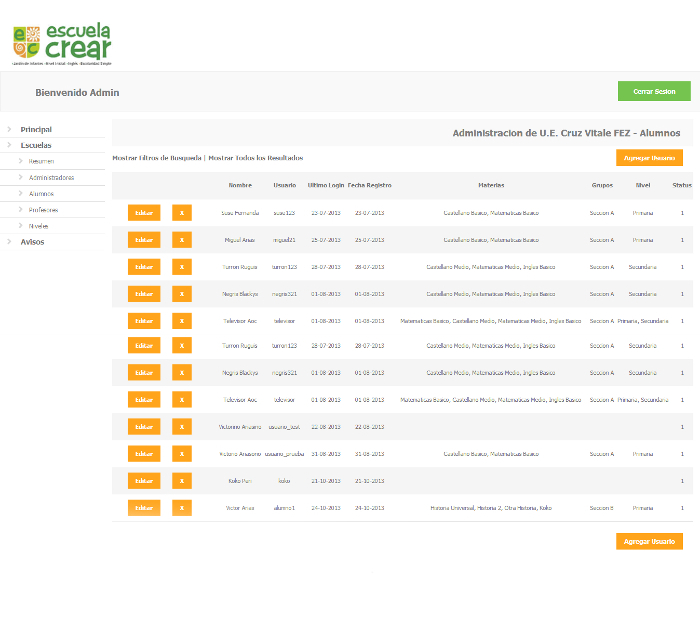
Multiescuelas is a network of schools whose admin system our remote team built from scratch: enrollments and students, users and permissions per school, subjects, groups and levels, grades and marks, billing, sync between schools and reports and notices for management. After the project operational efficiency rose 40% with 15 schools connected to the same system.
| Client | Multiescuelas |
| Industry | School network and academic management |
| Service | IT Outsourcing |
| Stack | Custom development, Multi-school admin system, Users and permissions per school, Enrollments and students, Grades and marks, Billing, Sync between schools, Reports and notices |
| Duration | More than 3 months |
| Our role | Custom development of the multi-school admin system by our remote team: enrollments and students, users and permissions per school, subjects, groups and levels, grades and marks, billing, sync between schools and reports and notices. |
| Published | December 12, 2024 |
In a network of schools the administrative problem is not visible from the outside: each site keeps its own records, its own enrollments and its own billing, and management has no way of knowing what is happening across the whole without asking for fifteen different reports.
Multiescuelas is a network of schools whose admin system our remote team built from scratch: enrollments and students, users and permissions per school, subjects, groups and levels, grades and marks, billing, sync between schools and reports and notices for management. After the project operational efficiency rose 40% with 15 schools connected to the same system.
The challenge: each school kept its administration separate
A school network grows by sites, and each site drags along its own way of working: spreadsheets, notebooks, scattered software. The result is an administration that works in isolation and a management team governing blind.
The same data in fifteen different places
One student, one enrollment, one payment: the same information repeated in every school with different criteria. Without a common system there is no comparison possible, and any consolidation becomes days of manual work.
A system that cannot stop in September
School administration has dates that do not move: enrollment period, assessments, monthly billing. A system for schools cannot afford a migration mid-year or an outage during sign-up week.
Data on minors is not handled any which way
A school system holds data on minors and families, which makes it essential to separate what each site sees, to control who can access what and to be careful with permissions. That is not a technical detail: it is the condition for the network to be able to share one platform.
The solution: a custom admin system, maintained by our team
The system was built from scratch and is maintained by our remote team, which is what defines outsourcing: the school network keeps a working system and the people who look after it, without having to set up its own technical department for something that is not its business.
 Behind every enrollment there is a family and a classroom: the system has to take the September peak without failing.
Enrollments, students and billing
Student registration, their data and monthly billing live in the same system, so administration stops depending on someone moving information from one place to another. It is the part that consumes the most time in a school and the one that shows most clearly when it is solved.
Users, permissions and separation by school
Each site works with its own users and its own permissions: whoever administers one school does not see the data of the others. That separation is what allows fifteen centres to share a single platform without mixing information or responsibilities.
Grades, reports, notices and sync
Subjects, groups and levels organise the academic offering; grades and marks are recorded in the system; reports and notices carry the information to management. And sync keeps every school up to date with the same criteria, which is what turns fifteen administrations into one network.
How we did it in more than three months
The project was planned in parts and with the system in use early on, because in a school environment the calendar rules: enrollments, assessments and billing have their dates and the work adapts to them, not the other way round.
 The system is built and changed without interrupting the school year: administration keeps running while it improves.
Starting with enrollments and billing
The first two pieces were the ones that remove the most administrative load: student registration and monthly billing. Starting there lets the system prove its value in the first cycle, before tackling the academic side.
Living with the school year
Changes were introduced without stopping administration, using the gaps in the school calendar and verifying that each school's data stayed separated and in sync. In a system with fifteen sites, the priority is that nobody loses a record to an update.
Results
The system was delivered with enrollments, users and permissions, grades, billing, sync and reports working across the network. These were the needs and how they were solved:
| Need | How it was solved |
| Each school keeping separate records | One system with data separated by school |
| Student registration and billing every year | Enrollments and billing inside the system |
| Nobody seeing another site's data | Users and permissions per school |
| Organising the academic offering | Subjects, groups and levels |
| Delivering grades and reports | Grades and marks recorded in the system |
| Letting management see the whole picture | Reports, notices and sync between schools |
The measured results of the project: operational efficiency rose 40% and the system connects 15 schools. Both figures tell the same story from different angles: when administration stops being repeated site by site, the time recovered goes back into education.
What a multi-school admin system needs
If you manage several sites or centres and each one works on its own, these are the points that decide whether a single system works:
- Data separated by site, because sharing a platform cannot mean sharing student information.
- Enrollments and billing built in, which is the administrative load that consumes the most time every year.
- Clear permissions per user, so each person sees exactly what corresponds to them.
- An ordered academic structure: subjects, groups and levels, so grades have somewhere to go.
- Sync between centres, which is what turns several administrations into one network.
- Someone to maintain it, in-house or outsourced, because a system without maintenance falls behind within months.
If your organisation needs a system like this and does not want to build a technical team to keep it running, our IT outsourcing page explains how we work, and you can write to us to go through it together.
Frequently asked questions
What does IT outsourcing add over hiring your own developer?
A full team — development, support and infrastructure — without the fixed cost of keeping it in-house. For a network of schools the admin system is essential, but it is not the business: a school sells education, not software. Outsourcing leaves the system with the people who work on it daily and the school focused on its own work.
Why centralise management across several schools?
Because each site kept its own records: the same data spread across fifteen different places, with no way to compare or consolidate. A single system with data separated by school makes it possible to see the whole picture without mixing each centre's information.
How do you work without interrupting the school year?
By building and changing in parts, with the system in use. Dates are not negotiable — enrollments, assessments and billing have their own calendar — so permissions separate what each school sees, data syncs and improvements go in without stopping administration.
How long does a multi-school admin system take?
This project took more than three months. The schedule is set by enrollments and students, users and permissions per school, subjects, groups and levels, grades and marks, billing, sync between schools and reports and notices.