 Victor Arias
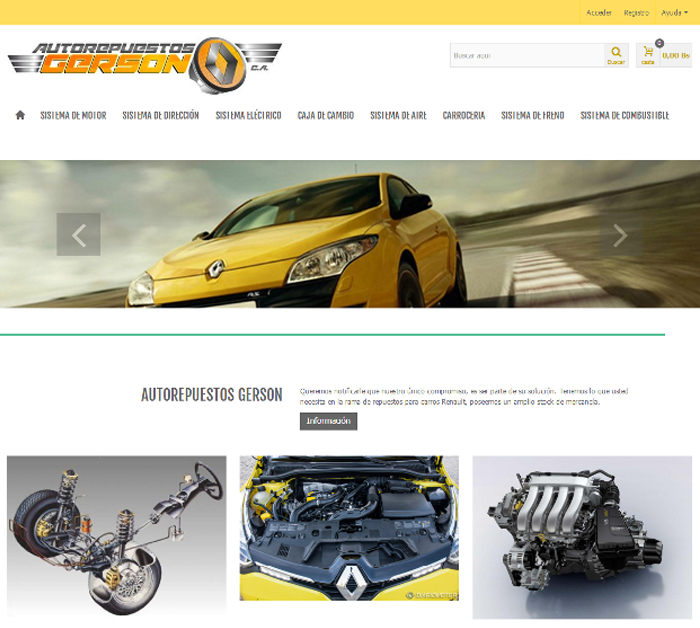
Auto Partes Gerson is an online car spare parts store built on PrestaShop with custom modules: the customer searches the part by make, model and year or by its reference and OEM code, sees the real inventory stock, buys with workshop or retail pricing and gets the order delivered. The project was delivered in one to two months and produced 130% more sales and 35% less search time.
| Client | Auto Partes Gerson |
| Industry | Car spare parts |
| Service | PrestaShop Development |
| Stack | PrestaShop, PHP, MySQL, Apache, Custom vehicle compatibility modules, Reference and OEM code search, Stock synchronisation with the inventory, Trade pricing for workshops |
| Duration | 1-2 months |
| Our role | Development of the PrestaShop store with custom modules: vehicle search, reference and OEM code lookup, stock synced with the inventory, trade pricing for workshops and home delivery. |
| Published | September 13, 2018 |
Buying a spare part is not like buying a book: the part has to fit a specific car, and that shapes the whole store. Auto Partes Gerson sold spare parts and needed customers to find their part on their own, without phoning to ask whether it would fit.
The store was built on PrestaShop with custom modules: vehicle search, reference and OEM code lookup, real inventory stock and trade pricing for workshops. The project was delivered in one to two months, with 130% more sales and 35% less search time.
The challenge: selling a part that has to fit
In a spare parts store the product is not chosen for what it is, but for the car it goes on. That turns three ordinary things — searching, checking and knowing whether there is stock — into the centre of the whole project.
The same part does not fit every car
A filter, a brake pad or a shock absorber changes with make, model and year. If the customer has to open page after page to read whether it fits, most never reach the cart: in spare parts, doubt is abandonment.
The customer arrives with the reference in hand
Many people buying spare parts already know what they want: they come with the reference written down or the original part code. Making that customer browse categories wastes their time right when the purchase was already solved before they arrived.
If stock lies, the sale goes to the next phone number
A workshop with a car off the road does not wait: if the site says it is in stock and it is not, they call another supplier. In this business stock is not informative data, it is the condition for the sale to happen, and it has to be the real inventory.
The solution: PrestaShop with custom modules
We started from PrestaShop and built the modules that make a spare parts store useful: vehicle compatibility, reference and OEM code search, the connection to the inventory and pricing by customer type. These are business rules, not template settings.
 In spare parts the catalog is ordered by references and compatibility: the store has to translate that into the customer's language, which is their car.
Vehicle search: make, model and year
The customer selects their car and the store shows only what fits. It is the natural way to search in this sector and the one that avoids the most expensive mistake in a spare parts store: selling a part that does not fit and swallowing the return.
Reference and OEM code search
For those who already know what they want, the store lets them paste the reference or the original code and reach the item directly. That short path is what turns a phone enquiry into a purchase made on the site.
Real stock and workshop pricing
The store shows inventory stock, so what is displayed is what exists, and applies different prices depending on whether the customer is an individual or a workshop. The order can be closed on the site or by phone and messaging, with home delivery.
How we implemented it in one to two months
The project came together quickly because the effort was not in the store, it was in the catalog: loading the references with their compatibility, fine-tuning the code search and connecting stock with the real inventory. With that working, the purchase flow was the fast part.
 A customer who brings the reference does not want to browse: they want to paste the code and see whether there is stock.
The catalog rules: compatibility and cross-references
Every reference was loaded with the vehicles it fits, and the OEM code search was tested with the real codes workshops work with. That is the part that decides whether the store gets it right or generates returns.
Testing the purchase as a workshop and as an individual
The whole journey was tested from both sides: the individual searching by vehicle and the workshop arriving with their price list and their reference. One catalog has to answer well to both, because they are two different ways of buying.
Results
The store was delivered with the catalog loaded and stock connected. These were the needs of the project and how they were solved:
| Need | How it was solved |
| The customer finding the part that fits | Search by make, model and year |
| Someone with the reference not having to browse | Reference and OEM code search |
| What is shown being what exists | Stock synced with the inventory |
| Selling to workshops and to individuals | Different prices depending on the customer type |
| Delivering the part and not losing the order | Home delivery and orders by phone or messaging |
The measured results of the project: 130% more sales and 35% less search time. Both figures tell the same story from different sides: when finding the part stops being a problem, the customer buys on the site instead of calling, and when stock is real, the sale does not collapse at the last step.
What a spare parts store needs
If you sell spare parts and are planning an online store, these are the points that decide whether it will sell or just exist:
- Vehicle search (make, model and year): that is how the customer thinks, not how the warehouse is organised.
- Reference or OEM code search, because many people arrive knowing exactly which part they want.
- Stock synced with the inventory: in this business, showing what you do not have means losing the customer for good.
- Trade pricing for workshops, who buy at a different price and with a different frequency.
- Clear compatibility on the product page, so nobody buys a part wondering whether it fits.
- Flexible ordering channels: website, phone or messaging, with home delivery.
If your catalog needs its own rules, our PrestaShop development page explains how we work, and you can write to us to go through your case.
Frequently asked questions
Why do spare parts need a search by vehicle instead of by name?
Because the same part changes with make, model and year: a filter, a brake pad or a shock absorber does not fit every car. If the customer has to read each product page to check whether it fits, most never reach the cart: they filter by their vehicle and only see what fits.
What does reference or OEM code search add?
That the customer who already knows what they want does not have to browse. In spare parts many people arrive with the reference written down or with the original part code, and being able to paste it and find the item directly is what prevents long searches, phone calls and returns from buying the wrong part.
Why is real stock critical in a spare parts store?
Because the customer does not wait: if the site says it is in stock and it is not, they pick up the phone and call someone else. In a workshop, a car waiting for a part is not an inconvenience, it is lost money, so the store has to show the real inventory and not a theoretical catalog.
How long does a spare parts store take?
This project was delivered in one to two months. The schedule is set by the catalog and its rules: loading the references with their vehicle compatibility, fine-tuning the OEM code search and connecting stock with the real inventory.